

Last updated: October 21, 2026
Quick Answer: for most small to medium lawns, the best sprinkler setup for new sod is usually two hose-end sprinklers on a hose timer, with overlapping coverage and enough hose length to place each sprinkler where its pattern overlaps the next one. That setup is often better than dragging one hose-end sprinkler around by hand, because new sod dries fast at the seams and at the edges.
[Key takeaways]
- Use two sprinklers instead of one if the lawn is wider than a single spray pattern.
- Favor overlap over maximum throw distance; the goal is even wetting, not farthest reach.
- A hose timer removes the guesswork and keeps short watering runs consistent.
- Oscillating sprinklers suit rectangular strips; rotary sprinklers suit wider or irregular spaces.
- Skip a complicated in-ground system if the sod area is temporary, small, or awkwardly shaped.
What the best sprinkler setup for new sod actually is
The best sprinkler setup for new sod is usually a hose-end system built around coverage, not force. For most small to medium yards, that means one or two hose-end sprinklers, a hose timer, and enough hose length to place each sprinkler where its pattern overlaps the next one by a meaningful amount.
That matters because new sod has shallow roots at first, and dry bands show up where spray patterns stop short. A single sprinkler placed in the middle often leaves corners, narrow runs, or far edges under-watered. A setup with overlap is safer because each part of the sod gets hit from two directions. That is the basic rule, whether the sprinkler is oscillating or rotary.
For example, a practical setup often looks like this:
- Rectangular lawn or side yard: one oscillating sprinkler per zone, placed so its spray reaches just past the far edge.
- Square or irregular lawn: two rotary sprinklers, set to cover a circle or partial circle and aimed to overlap in the center.
- Long, narrow strip: an oscillating sprinkler on a hose timer, shifted only if the strip is longer than the spray pattern.
The main trade-off is convenience versus precision. A single sprinkler is easier to set up, but it is also more likely to miss a strip of sod. Two sprinklers take a little more hose management, but they usually give better coverage than one oversized spray pattern that throws water onto sidewalks, driveways, or fences.
According to the University of California Agriculture and Natural Resources, newly planted lawns should be kept consistently moist during establishment, which is why even coverage matters more than max range. This is not the right approach for someone who wants a permanent, buried irrigation system with dedicated zones and matched precipitation rates. It is also not the best choice if the sod area is so large that you would need several hose runs just to keep up. In that case, a fixed system or a professional layout makes more sense than a patchwork of hose-end gear.
Which sprinkler type covers sod best?
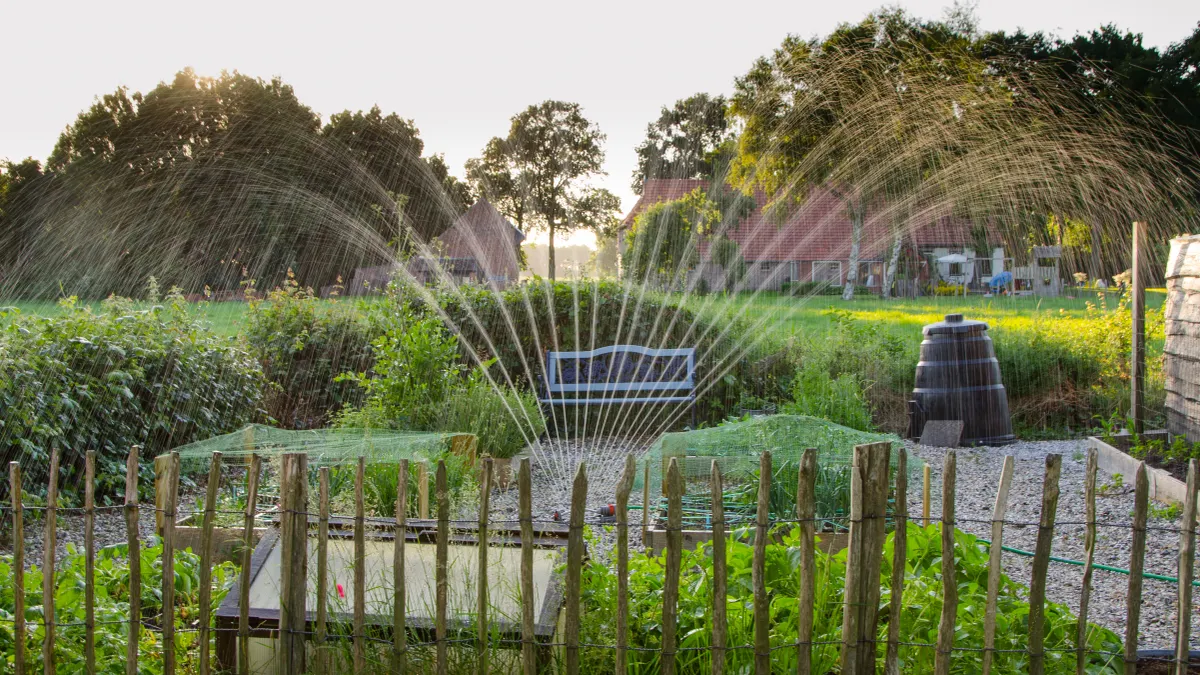
The right sprinkler type depends on the shape of the lawn, but oscillating sprinklers are usually best for rectangles and rotary sprinklers are usually best for larger or odd-shaped areas. That simple split saves a lot of frustration.
An oscillating sprinkler throws water in a fan pattern back and forth. It is easy to place for a 10-by-20-foot strip, a narrow front yard, or a straight edge along a patio. Its strength is even coverage in a predictable rectangle. Its weakness is that the ends of the pattern can be dry if the sprinkler is not centered correctly, and wind can push the fine spray off target.
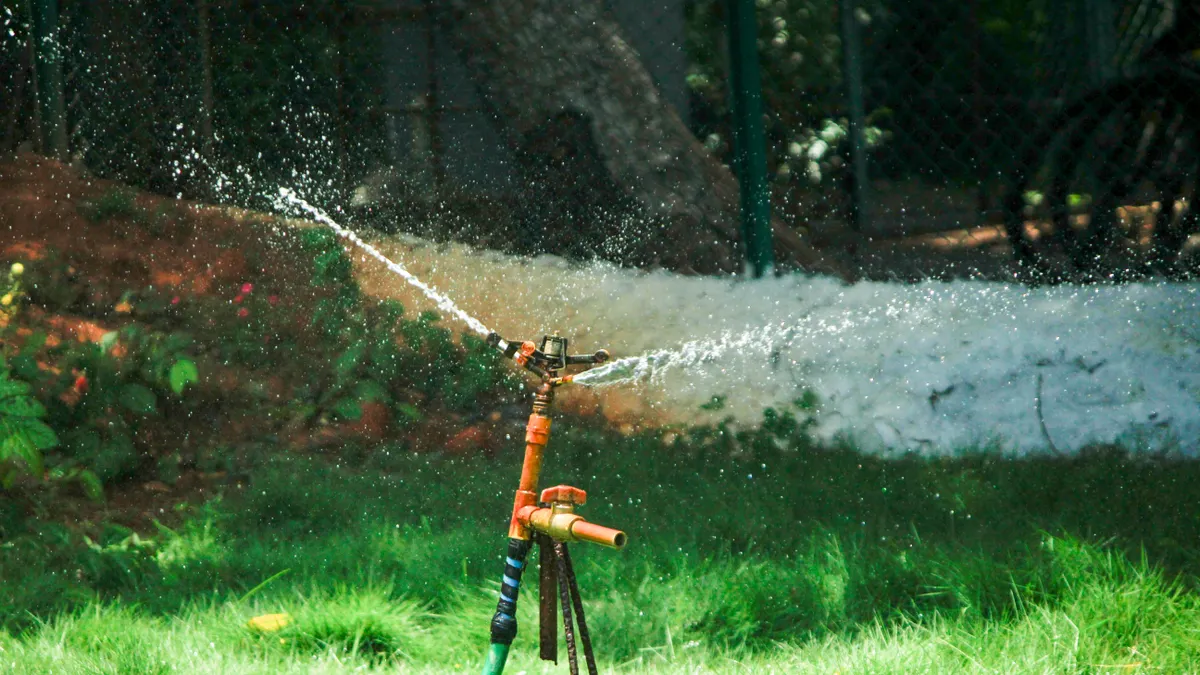
A rotary sprinkler sends rotating streams or pulses in a circular pattern. It handles wider lawns better, especially when you need partial circles or a pattern that can be adjusted around beds, walkways, or a curved edge. Its advantage is reach and control. Its drawback is that small gaps between streams can show up if the spacing is too wide, so overlap matters more than with a simple fan pattern.
For new sod, I would avoid choosing based on “highest output” or “furthest throw.” Those are the wrong metrics. Coverage shape is what counts. If the yard is rectangular and the edges are straight, an oscillating model is usually the cleaner fit. If the lawn bends around a bed, tree, or corner, a rotary model usually wastes less water on hardscape.
This is also where cheap hose-end heads can disappoint. Some models advertise wide coverage but deliver uneven distribution at the outer edge of the pattern. That is fine for established grass that can tolerate a few dry patches. It is a poor fit for sod that has just been laid and has no deep root system yet. If the model description does not clearly state the spray shape and adjustment range, that is a warning sign, not a bonus feature.
How do I set up sprinklers so the whole sod strip gets water?
Set the sprinklers so their patterns overlap by roughly a third of the spray width, then use a timer to keep each run consistent. That is the easiest way to avoid dry seams without flooding the same strip twice.
-
Map the sod shape with the hose first. Lay the hose along the edge or centerline of the area and place the sprinkler where it can cover the farthest dry point. You want the spray to reach the back edge with a little margin, not stop exactly on it.
-
Choose the spray pattern before turning water on. Set an oscillating sprinkler to the narrowest setting that still reaches the full width, or set a rotary head to the arc that matches the section. A smaller, cleaner pattern usually wastes less water than a broad one.
-
Place a second sprinkler where the first one fades out. If the sod is wider than one pattern, put the next sprinkler so the wet zones overlap. The overlap is the insurance policy; the seam is where sod dries first.
-
Adjust for overspray onto hard surfaces. If water is landing on the driveway, fence, or mulch bed, move the head inward or reduce the arc. New sod needs water, but the curb does not.
-
Attach a hose timer for repeatable runs. A basic hose timer lets you keep the same watering window every time without standing outside to remember it. Even a simple single-outlet timer is enough for one zone. For two sprinklers on separate runs, a dual-outlet timer can help, though it adds more setup.
-
Check the pattern at the far corners after 5 to 10 minutes. The goal is damp, evenly darkened sod across the whole area. If the corners are still pale while the middle is soaked, shift the sprinkler a foot or two and test again.
-
Keep hose bends gentle. A kinked hose lowers flow and can shrink the pattern. A smoother line gives a more stable spray than an over-tight curve around a bed or post.
According to the EPA WaterSense program, small changes in irrigation efficiency can reduce wasted water, which is another reason to keep the pattern tight and even. This setup works because it treats new sod like a short-term precision job, and if the lawn is unusually large or complex, it is worth consulting a local irrigation professional before committing to a layout. You are not trying to water the whole landscape at once. You are trying to deliver even coverage to one specific surface.
Should I use a hose timer with new sod?
Yes, a hose timer is one of the smartest parts of a new sod setup because it keeps watering runs consistent and reduces missed cycles. It is a convenience tool, but for this job, convenience also improves results.
A hose timer matters most when the sod is large enough that you would otherwise forget a run, under-water a corner, or leave the sprinkler on too long while doing something else. Even a basic battery-powered timer with one outlet can make a simple setup more reliable. If you need to alternate between two sections, a dual-outlet timer or a two-zone arrangement is more practical.
The main benefit is not automation for its own sake. It is repeatability. New sod responds badly to random watering lengths. One day is 12 minutes, the next is 30, and the coverage changes each time. A timer makes the system behave the same way every run. That matters more than fancy controls.
There are drawbacks. Cheap timers can be awkward to program, and some shutoffs are less intuitive than they should be. A model with too many modes can become a nuisance rather than a help. If the timer is confusing enough that you keep overriding it, it is the wrong timer for this job.
A timer also does not fix poor sprinkler placement. If the spray pattern misses a corner, automating the bad setup just repeats the mistake on schedule. So the order is important: set the coverage first, then add the timer. The timer is the finishing piece, not the foundation.
If the lawn is tiny and you can stand there to move one sprinkler by hand, a timer is optional. If the sod is large, split into sections, or exposed to hot afternoon sun, a timer earns its place quickly because it removes one more chance for inconsistency. The University of California and EPA guidance both support keeping new turf evenly watered during establishment, and a timer helps make that easier to manage.
What common mistakes ruin coverage on new sod?
The most common mistake is trying to cover too much ground with one sprinkler, and that usually leaves the edges weak. New sod fails first at the seams, the corners, and the spots where the spray never quite reaches.
The second mistake is chasing maximum range. A sprinkler that throws water 30 feet is not automatically better than one that covers 18 feet more evenly. Long throws often create mist, drift in wind, and wetter middles with dry ends. For new sod, evenness beats distance every time.
Another mistake is placing the sprinkler in the wrong spot and assuming the pattern will “take care of itself.” An oscillating sprinkler set too close to one edge can leave a dead strip on the far side. A rotary head set with the wrong arc can waste water on pavement. The cost is not just waste; it is patchy rooting and uneven color.
People also forget that hose layout affects coverage. A hose that kinks at a corner or pulls the sprinkler off level can distort the pattern enough to matter. A simple change of 2 or 3 feet can be the difference between full coverage and a dry line.
Finally, some setups are too complicated for the yard in front of them. If you need three sprinklers, two timers, and a web of hoses just to keep the sod wet, the setup is the wrong fit. A more permanent irrigation solution may be better than forcing hose-end equipment to do a job it was not meant to do.
The fix for most of these mistakes is boring but effective: smaller sections, more overlap, and a check of the far edge before you walk away. That approach is less dramatic than “full-yard blast mode,” but it is far better for new sod.
When is a hose-end sprinkler the wrong choice?
A hose-end sprinkler is the wrong choice when the sod area is too large, too fragmented, or too permanent for handheld coverage to stay even. At that point, the convenience of a portable setup disappears.
A hose-end system makes sense for a new install on a modest yard, a patch repair, or a temporary layout where the lawn shape is still changing. It is less suitable for a long-term landscape with multiple irrigation zones, steep shape changes, or areas that need separate control because of sun exposure and wind. In those cases, a fixed sprinkler system can provide better repeatability and less daily handling.
This is also not the best setup if the property has a lot of hard edges. Long driveways, walkways, retaining walls, and fences increase overspray and reduce usable coverage. If half the water is landing off-target, the sprinkler is working harder than it should.
One honest limitation of hose-end setups is that they rely on someone getting the placement right. That is manageable on a small lot, but it gets tedious as the area grows. A timer helps, yet it does not eliminate the need to move and aim equipment.
If the sod is on a very windy site, a rotary pattern may drift less than a fine mist, but no hose-end sprinkler solves wind completely. In that case, the better answer may be to water in smaller sections and accept that the setup needs more attention than a simple “set it and forget it” product can offer.
The practical rule is simple: use a hose-end sprinkler when the lawn shape and size still fit under one person’s control. Move up to a fixed system when they do not.
The setup I’d choose first for most new sod jobs
The setup I’d choose first for most new sod jobs is two hose-end sprinklers on a timer, with the sprinkler type matched to the lawn shape. That combination gives a balanced mix of coverage and convenience without overcomplicating a temporary project.
For a straight rectangle, I would start with oscillating sprinklers because they cover wide bands cleanly. For a curved or irregular area, I would use rotary sprinklers because they handle arcs and partial circles better. In both cases, I would aim for overlap rather than exact edge-to-edge contact. A little overlap is safer than a missed strip.
I would not choose a single oversized sprinkler if the yard has corners, narrow runs, or obstacles. I would not choose a complicated permanent system for a one-off sod patch unless the property already needs it. And I would not rely on a timer to fix poor placement.
The best setup is the one that gives the sod even moisture across the whole surface with the least daily fuss. That is why the answer is usually a simple hose-end system, not the fanciest product on the shelf.
For the broader sod care sequence, the hub guide on sod aftercare, maintenance, and troubleshooting can fill in the rest of the timeline once the watering hardware is set.
Drafted with AI; not yet reviewed by a person.